If you asked a digital marketing agency in Canada this question 18 months ago, the answer would have been simple: check your Google rankings. Today that answer is not wrong. It is just incomplete, and for some industries, significantly incomplete.
Generative AI search, ChatGPT, Perplexity, Google AI Overviews, Gemini, now represents a layer of discovery that traditional rank tracking does not capture. Users are asking AI questions and getting synthesised answers. Your brand is either cited in those answers or invisible in that context. For Canadian businesses, understanding and building AI visibility has become as fundamental as keyword rankings were five years ago.
The shift has happened faster than most brand teams have noticed. And the gap between businesses that have started optimising for it and those that have not is already measurable.
What AI Visibility Actually Means for Canadian Businesses
When someone asks ChatGPT “what is the best digital marketing agency in Toronto for e-commerce brands,” they do not get a list of links. They get a synthesised paragraph that names specific companies or describes what to look for. Your business either shapes that answer, through content that AI systems trust and cite, or it does not exist in that query context at all.
800M+ ChatGPT weekly active users globally. Google AI Overviews now appear in an estimated 30 to 40 percent of all search queries. For B2B buyers and anyone comparing vendors, AI-generated answers are increasingly where the research starts.
Research from GEO firm Brandlight found the overlap between top Google results and AI-cited sources has dropped from 70 percent to below 20 percent. That means AI engines are already choosing different sources than traditional search, and businesses not structured for AI citation are missing an entirely separate discovery layer.
How to Run a Free AI Visibility Audit in 30 Minutes
This costs nothing. It is also the foundation of every GEO strategy we build for clients at WeBeeSocial, because without this baseline, every content decision is guesswork.
Step 1 List your customer intent questions
Write 10 to 15 questions your ideal customer would ask an AI, conversational, not keyword strings.
“What should I look for in a digital marketing agency in Toronto” rather than “best digital marketing firms Canada.” Think like a user genuinely trying to solve a problem.
Step 2 Test each question across all three platforms
Open ChatGPT, Perplexity, and Google with AI Overviews active. Test each question fresh, in a new session or incognito window, so you see cold, unpersonalised responses. This is the view a new potential customer would have.
Step 3 Document your findings honestly
Does your brand appear? Which competitors do? Is your website cited as a source? Which questions produce answers that mention no brands at all, signalling a gap your competitors have not filled either? This document becomes your GEO roadmap.
Most Canadian businesses that run this audit for the first time discover they are largely invisible for the queries that matter most. The good news: this is fixable, and the fixes do not require rebuilding everything you have already built.
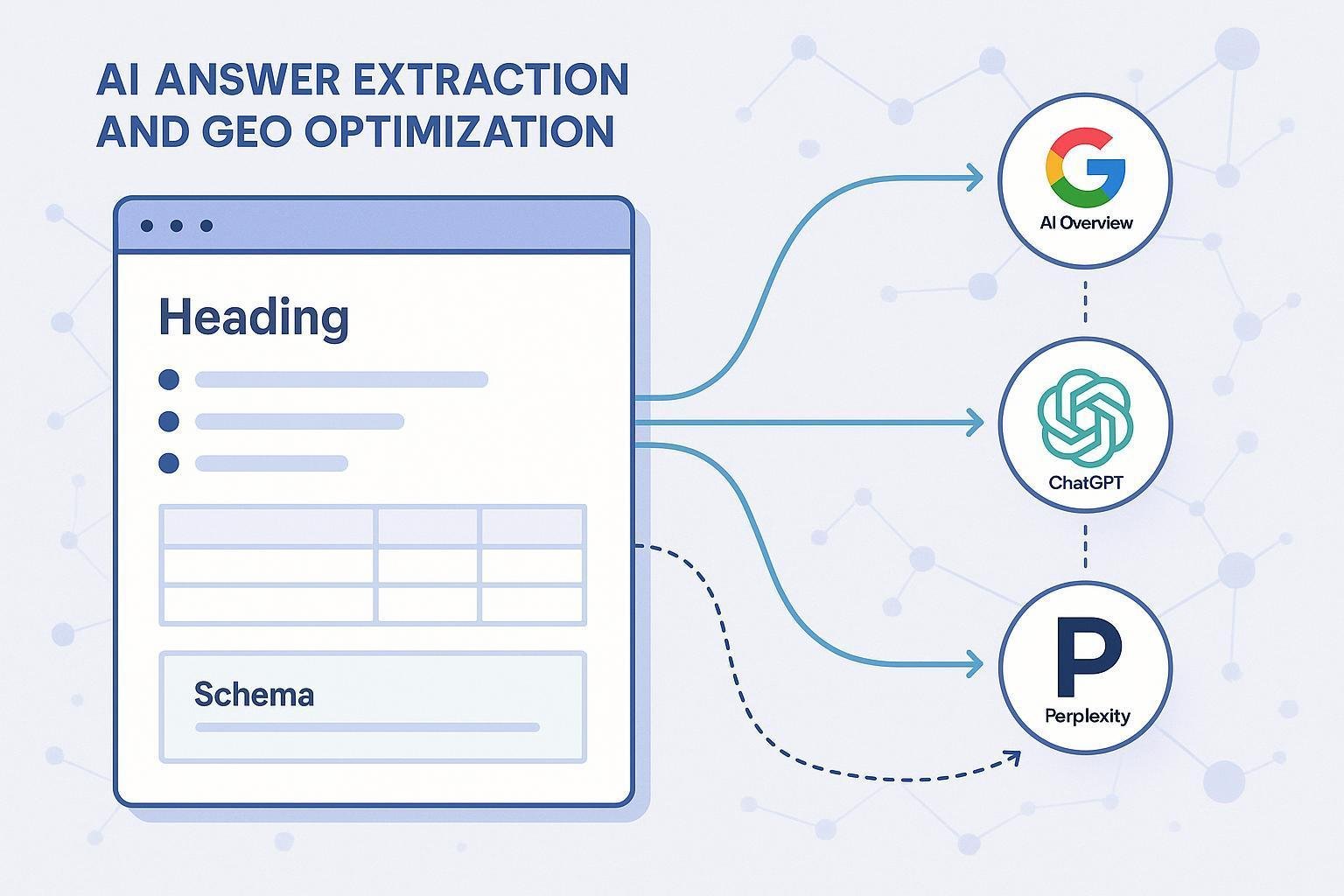
Why Your Brand Might Not Be Appearing, and What Actually Fixes It
AI systems look for what practitioners call citability, content structured so that a machine can extract a clear, verifiable answer to a specific question. Long brand introductions before the actual answer get skipped. Generic statements about delivering results get ignored.
The brands invisible in AI answers are not usually producing bad content. They are producing content structured for humans reading paragraphs, not for machines extracting answers.
This is the core of what our SEO team in Toronto means by Generative Engine Optimization. It is a shift in how you structure content, not a replacement for what you are already creating.
Here are the three structural fixes with the highest impact:
Direct-answer formatting: Place the answer to the page’s core question in the first two sentences of each section. AI engines do not read pages the way a human does, they extract the relevant answer block. Long preambles before the actual point get skipped every time. If your service page starts with your company history before explaining what you do, that suppresses your AI visibility immediately.
FAQ sections with schema markup: Content with FAQ schema shows 30 to 40 percent higher AI visibility across multiple GEO studies. Every service page should have three to five Q&A pairs written in natural, conversational language, the questions a real customer would actually ask. This also improves the experience for humans landing on your page, which matters just as much. Our SEO agency implements this as a standard layer across every client engagement.
Original data and specific claims: AI systems preferentially cite sources with unique, verifiable information. Generic statements are ignored. Specific claims, “we increased a Mississauga retailer’s organic traffic by 140 percent in eight months”, get extracted and cited. Case studies, original research, and specific outcome data are among the highest-value content assets a Canadian business can produce for AI visibility.
The Ongoing Tracking Requirement
AI citations are more volatile than traditional rankings, 40 to 60 percent of cited sources change month to month. Monthly audits using your core question set, combined with GA4 tracking for traffic from ChatGPT and Perplexity domains, give directional signal on whether your efforts are working.
This is not set-and-forget work. The Canadian businesses treating AI visibility as an ongoing discipline rather than a one-time project are building compounding advantages. Each month of consistent GEO work makes them harder to displace in the answers that matter, which is exactly the dynamic that strong traditional SEO created for businesses that invested early in organic search.
We also cover how brand identity and consistent digital messaging directly affect AI visibility in our piece on what brand identity actually means in 2026, and why a logo is only the beginning of that conversation.
At WeBeeSocial, we run complete AI Readiness Audits and build GEO content strategies for businesses across Toronto and Canada. If you want to know where your brand stands in AI search today, and what it would take to change it, let us have that conversation.
Your customers are already asking AI about your category.
The question is whether your business shows up in the answer. We can tell you, and fix it. Start with a free audit conversation.
Frequently Asked Questions
The most reliable method is manual: test 10 to 15 customer-intent questions monthly in ChatGPT, Perplexity, and Google AI Overviews and document whether your brand or website is cited. GA4 can also track referral traffic from AI platform domains. Dedicated GEO tracking tools like Brandlight or Semrush’s AIO monitor provide more systematic tracking at a cost. The manual audit is where every brand should start.
AI systems prioritise content that directly answers specific questions, contains verifiable statistics or specific claims, uses structured formatting with clear H2s and FAQ sections, has FAQ schema markup, and is published on authoritative domains with strong backlink profiles. Generic brand messaging and long preamble paragraphs are consistently skipped, which is why structured SEO and GEO strategy go hand in hand.
Content restructuring and schema implementation can show measurable improvements within four to eight weeks, as AI crawlers re-index pages. Building the third-party authority signals that AI platforms trust most, industry publication mentions, directory citations, reputable external links, takes three to six months of consistent effort. The businesses that start now have a meaningful head start by the end of 2026.
No. Google still drives significantly more traffic than all AI search platforms combined as of early 2026. GEO builds on SEO foundations, strong traditional rankings directly feed AI citation likelihood. The right approach for Canadian businesses is to optimize for both simultaneously, since many structural improvements that help AI visibility also improve traditional Google rankings. Our Toronto SEO team builds both into every engagement.
Recent Posts
All You have to do is fill out the form below, and our digital marketing experts will contact you.