What Is Brand Identity? Why a Digital Marketing Agency Looks Beyond the Logo
Every month we have some version of the same initial call. A founder or marketing manager says: “We need a new logo. The current one looks dated.”
Within 20 minutes of conversation, the logo is the last thing we end up talking about. Because a new logo, on its own, does not change how people feel about a business. It does not clarify the positioning. It does not fix the inconsistency between what the company says it is and how it actually behaves across every touchpoint where a customer encounters it.
As a digital marketing agency in Canada that has built brand systems for businesses across Toronto and beyond, this is the contrast we sit with constantly. So here is how brand identity actually works, why it matters more in 2026 than it ever has, and what a successful strategy looks like when you approach it the right way.
Brand Identity, Brand, and Logo: The Actual Definitions
Your logo is a mark. An extremely important one, it must be distinct, scalable, and suited to your product or service category. But it is one element of a much larger system.
Your brand is the total impression your business creates whenever it interacts with someone, through the answer your customer service gives when something goes wrong, through the design of your invoice, through how an employee describes your company at a networking event. It is the image people hold of your business when you are not in the room. You have a major influence over that image. You do not have complete control.

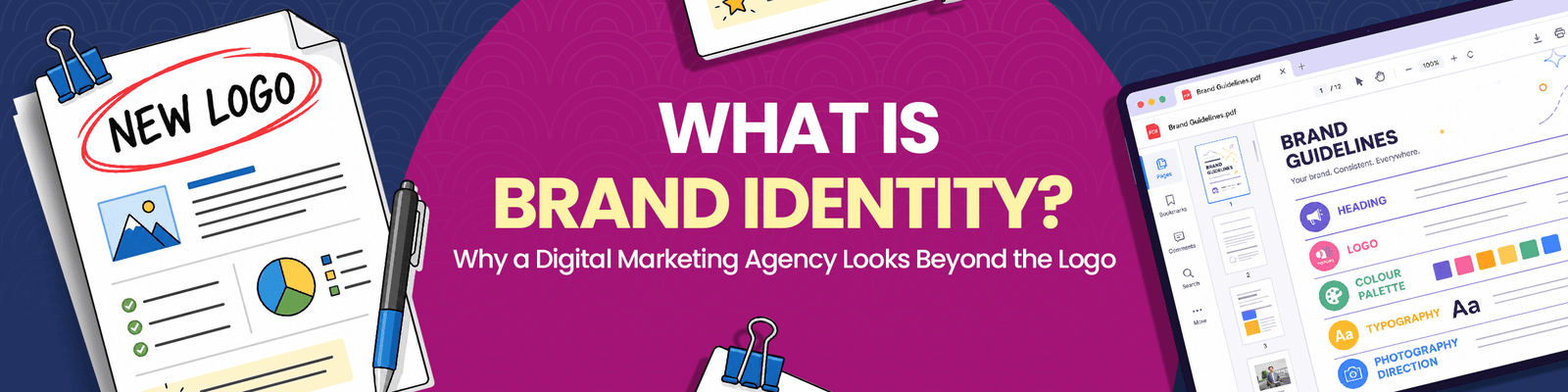
Your brand identity system is the actual toolkit you design and deploy to shape that impression consistently. Visually: logo, colour palette, typography, photography direction. Verbally: tone of voice, messaging architecture, value statements. When a design and copywriting agency does brand identity correctly, all of this creative development comes at the end, after the strategy is done, not instead of it.
Why Consistency Across Every Touchpoint Drives Real Commercial Outcomes
A consistently presented brand sees revenue increases of up to 33 percent, according to the Lucidpress Brand Consistency Report. That figure surprises people who think of branding primarily as aesthetics. It makes complete sense once you understand the mechanism: consistent brands are easier to recognise, more credible, and far more memorable. Trust is built through repetition, and repetition requires consistency.
Brand inconsistency does the opposite. Multiple logo variations across platforms. A website that sounds formal while Instagram sounds casual. Visual identity that changes completely between print and digital. Customers can feel when something is off, even if they cannot articulate exactly what. That ambient unease erodes the trust that every brand needs to convert.
A new logo does not fix brand inconsistency. It just gives you a new inconsistent element to add to the pile. The fix is strategic, and it starts before anything gets designed.
The Strategic Questions That Come Before Any Design Brief
The branding work that actually moves commercial performance begins with three questions that sound deceptively simple.
The three questions every brand must answer honestly:
mple.
- Who are you?
- Who are you for?
- How are you different from every competitor who appears to be selling the exact same thing?
Answering them honestly requires research, customer interviews, competitor positioning analysis, and internal alignment conversations. Most businesses find that different departments answer all three questions completely differently. The creative director says premium and authoritative. The sales team says friendly and approachable. The website says something else entirely. There is no redesigning that misalignment away. You can only resolve it strategically, before the design brief is written.
Any good digital marketing advertising agency will tell you there is nothing wrong with doing the strategic work first, before anything else gets designed. The briefing process that shapes every design decision makes no sense until those three questions are answered, and answered the same way by everyone who speaks for the brand.
Brand Identity in the AI Search Era, A Function It Did Not Have Before
In 2026, brand identity has a function it did not have five years ago: it shapes how AI systems perceive and describe your business to people who have never heard of you.
When ChatGPT or Perplexity answers a question about the best digital marketing agency in Canada for a specific need, it draws on signals across the web about who you are, what you do, and how others describe you. Brands with clear, consistent identity signals, a defined category, coherent messaging across their website and PR, distinctive positioning language that appears consistently in third-party mentions, are more likely to be cited accurately and favourably in those AI-generated answers.
Brand identity is now an AI visibility asset. Clarity and consistency in how you describe yourself, across every digital surface, every page, every press mention, directly affects how AI systems describe you to potential customers who are already looking for what you offer.
We cover the mechanics of this in detail in our guide on AI search visibility for Canadian businesses.
The brands that get this right are not just more recognizable to humans. They are more citable by machines. And in 2026, that combination is what sustainable brand authority looks like.
At WeBeeSocial, we build brand identity systems for Canadian businesses that work across every touchpoint, visual, verbal, digital, and AI. If you are ready to build something that is consistent, clear, and built for how your customers actually find you today, we are one conversation away.
Your brand is saying something right now. The question is whether it’s what you intended.
We build brand identity systems for Canadian businesses, from strategy through to design, copy, and digital. Let’s talk about your brand.
Frequently Asked Questions
A logo is one visual mark, important, but one element of a much larger system. Brand identity is the full toolkit a business uses to communicate: logo, colour palette, typography, photography style, tone of voice, messaging, and value statements. A strong brand identity ensures everything looks, sounds, and feels consistent to the customer across every platform and every interaction. Think of the logo as one instrument in an orchestra, brand identity is the whole score.
Working with a design and copywriting agency, building a complete brand identity typically takes 8 to 14 weeks. This covers strategic positioning, visual identity development, verbal identity, and brand guidelines. More complex projects, multi-product brand architecture or full rebrands of established businesses, take longer. The strategic phase is just as time-intensive as the design phase, and just as important to get right.
A clearly defined brand identity helps search engines understand what your business is and who it is for, which directly supports your SEO performance. For AI systems like ChatGPT and Perplexity, brands with consistent, clearly defined positioning language that appears coherently across their website, blog, and third-party mentions are more likely to be cited correctly and favourably when users ask about businesses in your category. Brand clarity is an AI visibility asset in 2026, not just a marketing one.
Recent Posts
All You have to do is fill out the form below, and our digital marketing experts will contact you.